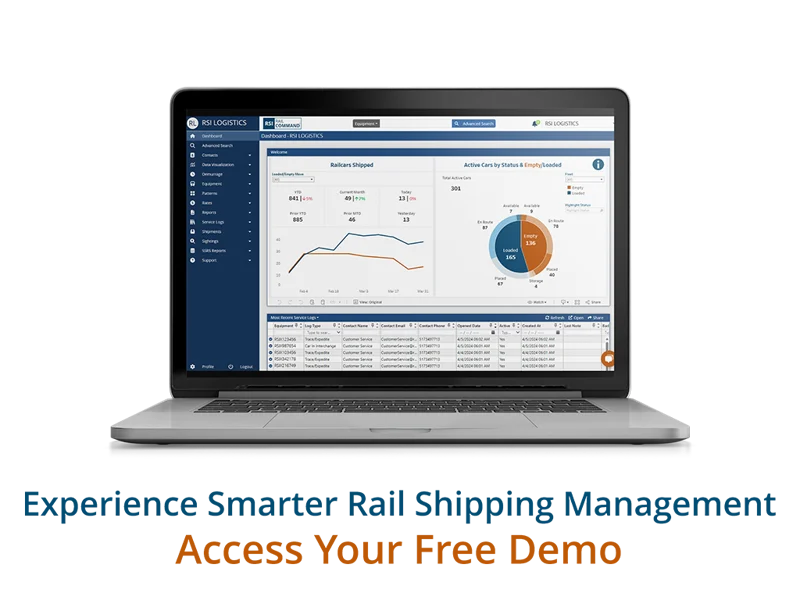
Managing rail logistics is more challenging than ever. Freight costs are rising, service expectations are tighter, and data is fragmented. Logistics teams are managing these growing responsibilities with leaner resources and limited tools. The solution? Rail Transportation Management System (Rail TMS) – rail freight software such as Rail Command®.
For many shippers, the tools they use are disconnected and manual, like spreadsheets that lack the scalability and integration shippers need in today’s rail landscape. As rail logistics become more complex, this disconnect eventually bottlenecks operations and costs shippers more time and money. A Rail TMS helps eliminate this inefficiency by centralizing communications, tasks, and data, all in one integrated platform.
At RSI Logistics, we’ve spent over forty years helping shippers move from outdated systems to smarter rail freight strategies. A modern Rail TMS, like Rail Command, doesn’t just improve operations, it transforms them. From reducing costs to improving visibility, we see a similar result: once the right system is in place, logistics become less complex and more efficient.
Here’s how a Rail TMS delivers value across the supply chain, and why more shippers are making it a priority. Some of our rail logistics experts have also chimed in with their thoughts on the value they see every day while working with our clients.
Table of Contents
- Unify Operations with Centralized Rail Data
- Turn Visibility into Savings with Real-Time Insights
- Streamline, Synchronize, and Solve Faster
- Smarter, Scalable Operations
Unify Operations with Centralized Rail Data
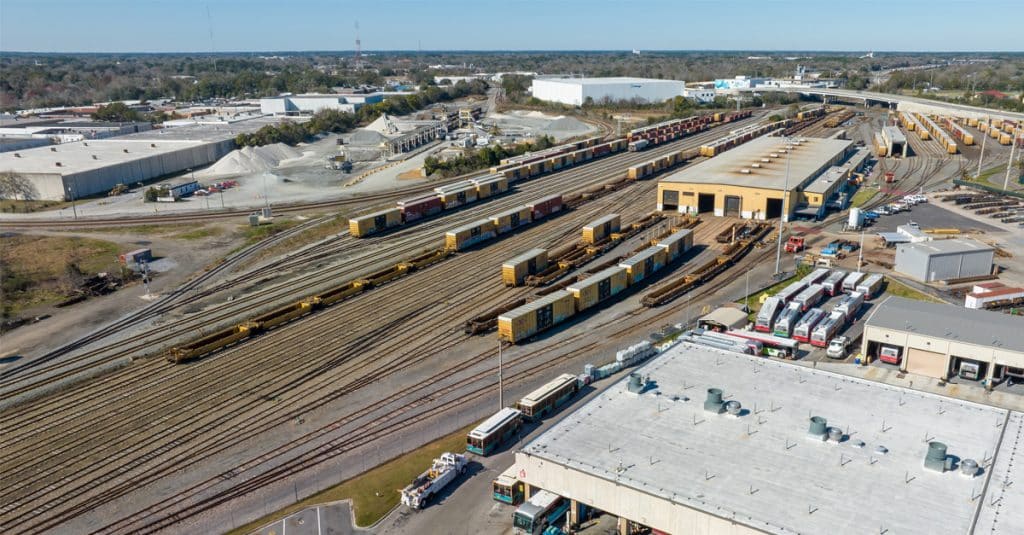
One of the most common challenges in rail logistics is siloed data. Logistics staff at the facilities and plants see one part of the picture, while billing teams rely on another. Operations teams and management are left to piece the information together after the fact, often from static reports or spreadsheets that run the risk of already being outdated or having manual entry errors.
A Rail TMS eliminates those silos by bringing all data into one platform.
“With Rail Command, shippers gain visibility into rail costs and demurrage, leading to smarter financial decisions that directly cut operational overhead. In 2024, our tools delivered significant impact, resulting in $3 million in freight savings for businesses using our Rail TMS.
Clients also use Rail Command to monitor fleet utilization, enabling data-driven decisions that optimize asset performance. It’s all about simplifying rail operations and driving measurable results.” – RSI Account Specialist
That kind of transparency doesn’t just help operations, it helps leadership make more confident, data-backed decisions across the supply chain.
Turn Visibility into Savings with Real-Time Insights
Reducing costs is still the top priority for most rail shippers. A Rail TMS helps with these challenges in several ways, beginning with automation. It can take over manual tasks such as exceptions, location information, and data visualizations, reducing the risk of human error and saving administrative time each week.
It also gives shippers the visibility they need to avoid preventable costs.
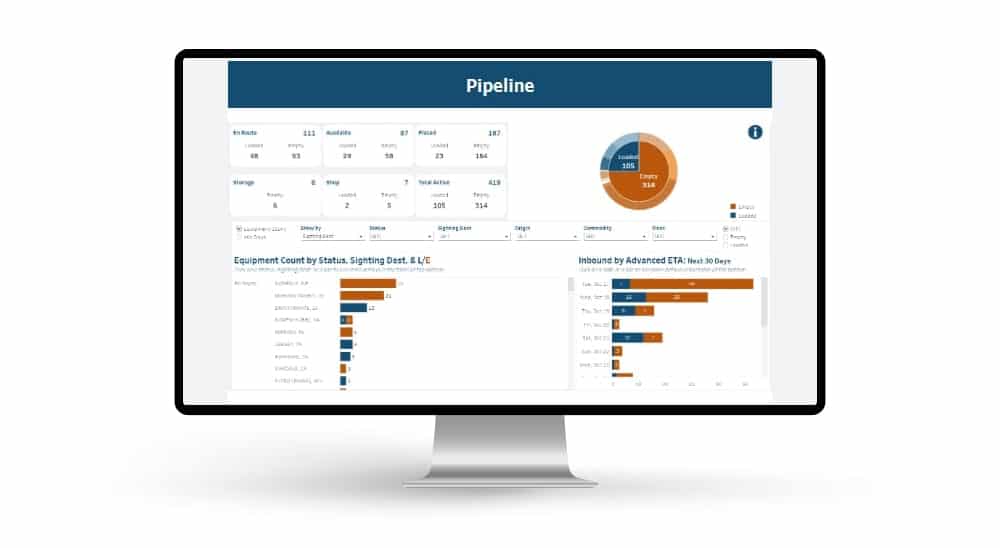
“By providing a comprehensive view of a shipper’s fleet, Rail Command can help shippers find insights into pinch points or bunching of railcars, and in turn allow them to act proactively and decrease their cycle times.” – RSI Solutions Engineer.
Those faster turns mean less dwell time, less demurrage, and fewer delays – all of which add up.
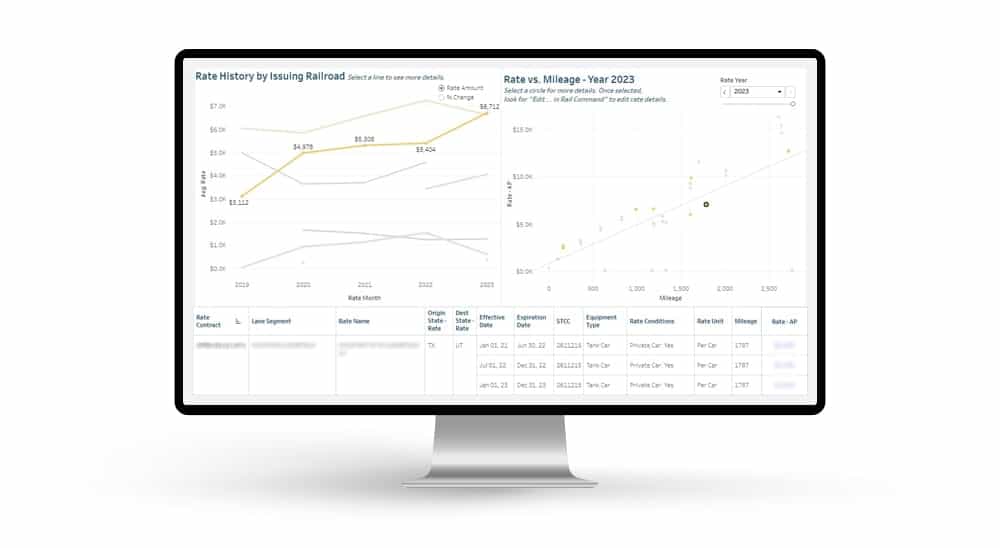
“Rail Command gives our clients clear insights into operational costs and empowers better decision-making, especially when managing rates and demurrage. In 2024 our clients realized demurrage savings of 29% of the total amount invoiced.” – RSI Strategic Project Specialist
With clearer cost visibility, teams can identify areas of their supply chain for optimization, and course correct before those inefficiencies become expensive.
Streamline, Synchronize, and Solve Faster
Rail freight software isn’t just about automation, it’s also about coordination. When teams are relying on email chains, phone calls, or disconnected systems to stay updated, small issues can easily become major disruptions.
A Rail TMS gives everyone, from facilities to operations to management, a shared view of what’s happening.
“Rail Command bridges the gap between schedulers and plant personnel by automating scheduling, tracking, and billing. It reduces admin tasks and minimizes human error, giving teams the speed and reliability they need.” – RSI Strategic Project Specialist
This kind of alignment is especially valuable for smaller or overstretched logistics teams. By removing manual friction, your team can focus on solving problems, not finding them. It also improves communication with rail carriers and customers, giving them a better handle on delivery timelines, exceptions, and status updates.
Smarter, Scalable Operations
Rail freight software also lays the groundwork for long-term improvement. Once your data is centralized, it becomes usable, not just for tracking railcars, but for building smarter supply chain strategies.
All of this adds up to smarter operations. With a Rail TMS in place, rail shippers can analyze trends, monitor performance, and make informed decisions, not just gut calls.
“Rail Command offer measurable value by enhancing efficiency, visibility, and cost reduction within supply chains. It helps companies optimize routes, manage freight intelligently, and improve on-time delivery while controlling costs.” – RSI Senior Director of Services Integration
With a Rail TMS, shippers can analyze performance by lane, carrier, facility, or timeframe. They can compare costs month over month, measure compliance, and spot patterns that lead to improvement. And as technology advances, particularly in Artificial Intelligence and Machine Learning, a modern Rail TMS will serve as a foundation for proactive, automated decision-making.
In an industry where margins depend on precision and efficiency, a Rail TMS isn’t a luxury, it’s a necessity. A Rail TMS takes fragmented processes and systems, then transforms them into streamlined operations that save time, reduce costs, and improve visibility. Rail Command delivers exactly that.
If you’re still relying on spreadsheets, phone calls, and manual work to manage your rail operations, it may be time to modernize. Discover how Rail Command empowers better decisions and lower costs across your rail operation. Schedule a demo today to see actionable insights in motion.